
Disturbing the Seasons by Ann Shaffer

Disturbing the Seasons
by Ann Shaffer
My mother isn't dead yet,
and sometimes I think of her that way--
my mother, who has yet to die.
She calls from where she lives,
says she's fine,
and I believe her.
My voice travels a long way back to her,
out of this city, west through a dozen counties,
across the river.
I think of how ordinary her death will be.
My grief, as common as dirt.
When we say good-bye,
I go back to the garden
and get down on my knees.
I should gather amulets
when the time comes,
gold coins for the passage,
a thousand horsemen carved in clay
to serve her in the underworld.
But all I have are weeds--
thistles, purslane, loosestrife.
The pile grows as I work,
and the long, white taproots shine like bone
against the withering greens.
Then I pull out a tangle of chamomile
and toss it on the mound.
There's mint, too, run rank through the roses;
maple seedlings;
young strawberries strangling the corn.
This time of year
there's nothing else:
a token of wood, to build her boat;
the berries, hard fruit for the journey;
herbs, to help her sleep.
To comfort myself, I throw on flowers,
rosebuds, columbine, and rue.
But all the meanings are lost to me,
lost with the language of elegy.
This poem was published in Poetry, in the June 1994 issue. It's a great issue (honestly, there is not a dud in the bunch), and you can check out this and other poems from it here.
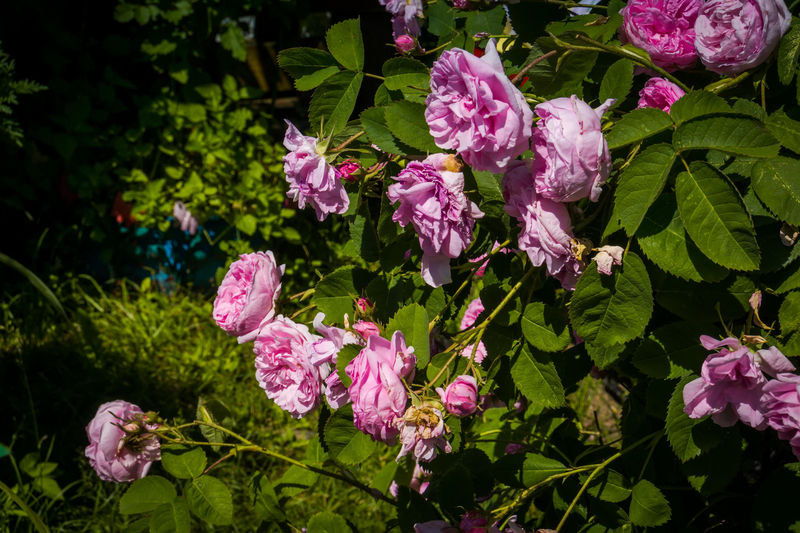
Today is the 3rd anniversary of my mother's death and our roses and many of our other flowers and plants are blooming like mad, so it was easy for me to relate to the crazy mess of feelings and thoughts in this poem.
I love how this poem travels. It begins with non-death, moves to the long distance phone calls that connect many of us to our mothers, or did. There is a sad acceptance of what is to come; we know from the second stanza that the mother is not fine. How not fine, we are not told. But we are told that the speaker's mother's deaths, as with most deaths, will be ordinary and the speaker's grief, like that of most of us when our mothers die, will be "as common as dirt."
That idiom, which is not as common as it used to be, is particularly apt here, for we then move outside and into the dirt. The speaker's brain is still on her mother's death, and she tells herself (and us, of course) that she should collect amulets, coins, and clay figurines to
help her mother's passage into the next world.
"But all I have are weeds," weeds she has pulled. She then starts adding non-weeds to her pile: chamomile, mint, seedlings, strawberries. It is such an odd mix, but it also forces us to use our senses. The speaker is touching these things, but their scents, colors, and flavors come to us.
The speaker continues to think of helping her mother using old myths as her guide; her mother will need a boat (I assume to cross the River Styx), things to eat, and something "to help her sleep." This is especially touching, the care the speaker is considering for her mother after she passes.
In the last stanza, she admits that her pile is helping her, is bringing her comfort. She adds flowers: roses, columbine, and rue. In the Victorian Language of Flowers, roses had many meanings, usually dependent on color. Black roses symbolize death and dark red ones symbolize mourning. Rue symbolizes sorrow and regrets. Columbine can symbolize a mother's love.
This mix of symbols/feelings fits the poem; the speaker is already in mourning for a death that has not yet happened. In the last two lines, the speaker says she's not recognizing the Language of Flowers (maybe not, but the poet was when choosing those three flowers to list in this poem) because she is already thinking about the language of elegy. Again, she is already in mourning.
I understand this. Anyone who has watched a loved one weaken with age and/or a debilitating disease will understand this. Grief does not wait for the actual death.
I could only find 2 other poems by Ann Shaffer online, and they are here.


Comments